
- A successful physical stock count is 80% decided before the big day: shelves tidied, products labelled, receipts and returns up to date, movements frozen during counting.
- A full inventory once or twice a year, a cycle count every week on one product family: the two complement each other, they don't compete.
- An inventory discrepancy is almost never a mystery: data-entry errors, undeclared breakage, badly recorded returns and unknown shrinkage explain nearly all the differences.
- Every correction must go through a traced stock adjustment — store, product, quantity, date and internal note — never through a "discreet" tweak of the quantities.
- With a connected till like PosXT (from 299 MAD (excl. VAT) per month, 14-day free trial), theoretical stock is reliable down to the product, and inventory becomes a verification, no longer a reconstruction.
Taking a store inventory means answering a simple question: does what your system believes is in stock match what's actually on the shelves and in the stockroom? Many merchants put the exercise off — too long, too painful, discouraging results — and steer all year long on wrong numbers. Yet a well-run inventory takes a day, reveals where the money is going, and puts the shop back on healthy foundations. This guide walks through the complete method: the right rhythm, the preparation, counting day, calculating the discrepancies, the clean stock adjustment, and the decisions to make right afterwards.
Why inventory feels daunting (and why it pays off)
If the physical stock count has a bad reputation, it's rarely because of the counting itself. It's because it's done in bad conditions: without preparation, without a reliable list, on stock that's never tracked — and it ends late into the night with numbers nobody believes. The three classic fears:
- "It will take days." True if the stockroom is a mess and nothing is labelled. False if the store is prepared: a shop with a few thousand references can be counted in a day with two or three people.
- "We'll find discrepancies everywhere." Probably, the first time. But a discrepancy discovered is a discrepancy you can correct and prevent from recurring; a discrepancy ignored keeps costing you every month.
- "It'll be wrong again in a month anyway." Only if the daily movements — sales, receipts, returns, breakage — don't go through the system. That's precisely what the inventory is there to verify.
On the other side, what the inventory brings is very concrete. First, an accurate stock valuation: your stock is often the equivalent of several months of cash sitting on the shelves; knowing what it's really worth changes your purchasing decisions. Next, a figure on shrinkage: you finally discover how much breakage, errors and unexplained losses cost you — and where they concentrate. Finally, reliable sales data: accurate theoretical stock means stockouts avoided, restocking at the right time, and a margin calculated on reality. An annual inventory that reveals 2% shrinkage on a stock of 300,000 DH is 6,000 DH pinpointed — and partly recoverable from the very next year.
Full inventory or cycle count: which to choose
Short answer: both, at different rhythms. They're two complementary tools, not two rival schools.
The full inventory counts the entire store and stockroom in one go, generally once or twice a year, at a quiet time (end of the financial year, before a busy season). Its strengths: a complete snapshot of the stock, an exact stock valuation at a given date, a clean basis for the accounts. Its constraint: you have to close the store or count outside opening hours, mobilize the team, and freeze all movements for the duration of the count.
The cycle count counts a small portion of the stock at regular intervals — one product family per week, one aisle every two weeks — without closing the shop. Its strengths: discrepancies are detected fast (a discrepancy spotted a week after its cause can be explained; six months later, it can't), the effort is spread over the year, and the team keeps the discipline reflex. Its constraint: it demands consistency and theoretical stock kept up to date, without which you're counting into the void.
The right mix for most shops: one full inventory per year, plus a weekly cycle count targeted at the risk zones — expensive products, small items easy to lose, the families that showed discrepancies at the last full inventory, and the best sellers whose stockout costs the most. If you run several points of sale, count each store separately: the stocks are distinct, the discrepancies too, and transfers between stores must be recorded as traced movements, never as "hand-to-hand" exits — otherwise store A's inventory will show a shortage that's actually sleeping at store B.
Preparing the inventory: tidy, label, freeze
A successful inventory is decided before the first count. The preparation fits in three verbs:
Tidy. In the week before, put every product back in its place: items lost in the wrong aisle, opened boxes in the stockroom, returns lingering behind the counter. Group identical references in the same spot — counting the same product in three different locations is the number one source of errors and double counts. Take the opportunity to isolate, in a dedicated zone, anything that shouldn't be counted as sellable stock: broken items, goods on consignment, the store's own equipment.
Label. Every reference must be identifiable without hesitation. This is the moment to catch up on unlabelled products: in PosXT, you can print batches of barcode labels by store and by quantity before shelving — a scannable product is counted in a second, a product you have to hunt for in the list takes thirty. Check the units too: if a product is bought by the carton and sold by the piece, decide in advance which unit you count in, and note it on the count sheets.
Freeze. Theoretical stock must be closed off cleanly before counting: all supplier receipts entered, all customer returns recorded, all transfers between stores validated. During the count itself, no more movements: no sales (store closed or counting outside hours), no receipts, no exits. A carton delivered in the middle of the inventory is a guaranteed artificial discrepancy. If you absolutely must sell during the inventory, count zone by zone and lock only the zone in progress — but the simplest option remains picking a quiet day and closing for a few hours.
The big day: counting fast and accurately
Counting is a matter of organization, not courage. The setup that works:
- Divide the store into zones. Aisle by aisle, shelf by shelf, stockroom bay by bay. Each zone gets a number, each zone has an owner, and a counted zone is marked as such. Nobody "counts a bit of everything": that's the guarantee of counting everything once, and only once.
- Work in pairs. One counts and calls out, the other enters or writes down. In pairs, you go faster and you check each other. For sensitive zones — expensive products, small items — have a different pair recount: that's the double count, the best insurance against errors.
- Scan rather than write. A barcode scanner connected to the till or an entry sheet eliminates reference errors: scan the label, enter the quantity, move on. Products prepared in the previous step are counted at the rate of one per second.
- Count what you see, not what you believe. A "normally full" carton gets opened and checked. A product that can't be found is recorded at zero — that's precisely the information you're looking for. Ban the "it's roughly that": an approximate inventory is worse than no inventory, because it builds confidence in wrong numbers.
- Note anomalies as you go. Damaged item, opened packaging, unlabelled product, unknown reference: every oddity goes on a separate list, to be handled after the count — you don't stop, you note.
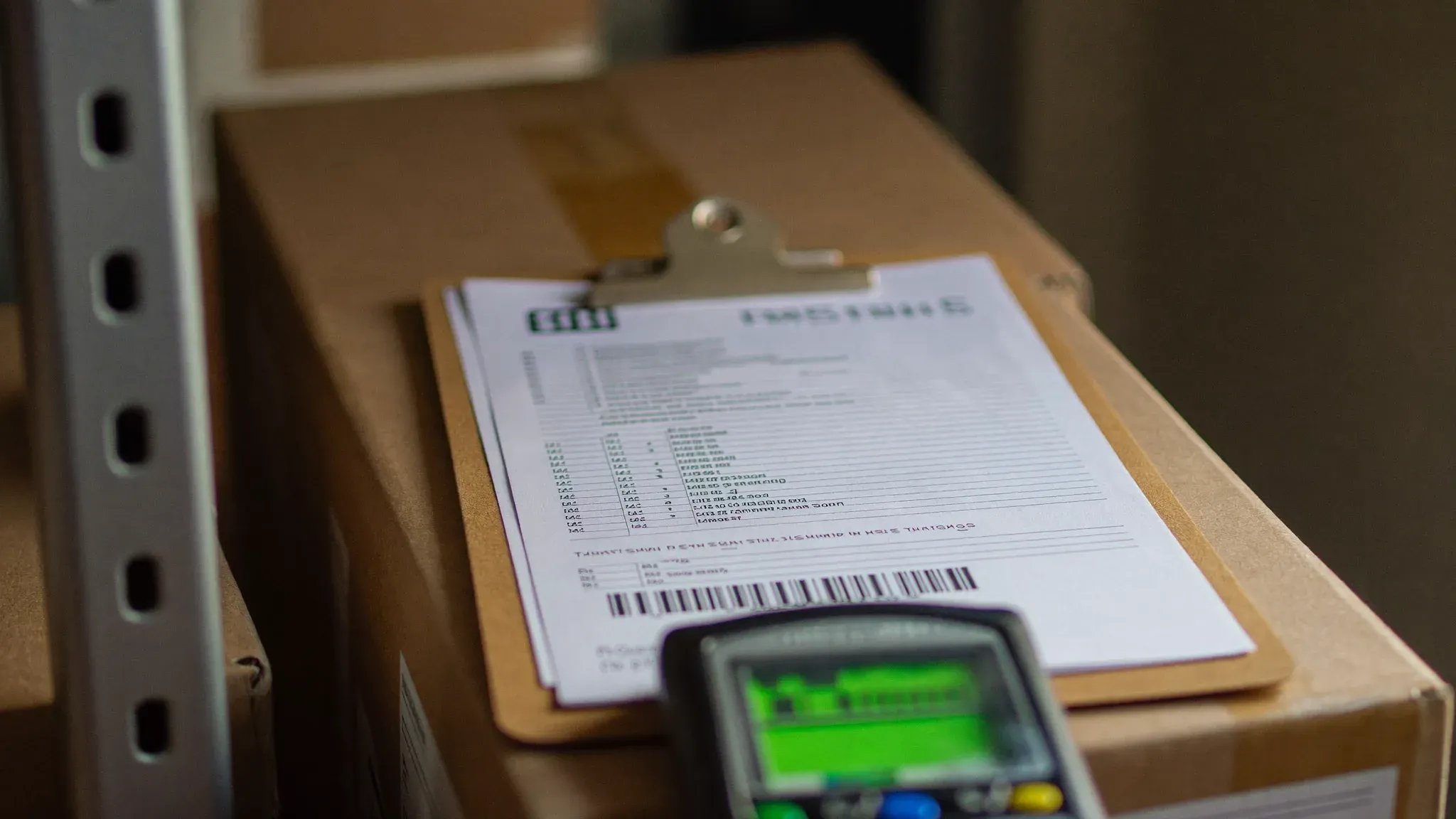
On pacing: plan breaks, water, and a posted target of zones per hour. Fatigue is the enemy of counting — errors concentrate at the end of the session. Two fresh half-days beat one marathon day that ends in approximations. And keep the same person in charge from start to finish: they settle the doubtful cases and confirm that no zone has been forgotten.
Entering counts and calculating discrepancies
Counting done, on to the reconciliation. The principle is simple: for each reference, you compare the counted quantity (reality) with the theoretical quantity (what the system expected). The difference is the inventory discrepancy — positive when you find more than expected, negative when something is missing.
Two entry rules to avoid polluting the result:
- Enter everything before analyzing anything. Correcting "as you go" when the first discrepancies appear makes you lose the big picture and mixes counting with interpretation. Enter, finish, then analyze.
- Verify the huge discrepancies before validating them. A 40-piece discrepancy on a reference that sells 5 a month is almost always a counting or unit error (a carton counted as one piece, or the reverse). Go back to the aisle before writing anything into the system.
Then express the discrepancies in two ways: in quantity (useful for spotting handling errors) and in value (at purchase cost — the one your cash flow understands). Ten missing pieces at 8 DH and two missing pieces at 400 DH don't call for the same urgency. This double reading also gives you your shrinkage rate: the total value of the missing items relative to the period's revenue. It's the number to follow from one inventory to the next: if it falls, your processes are improving; if it rises, something is degrading and you need to find where.
Analyzing discrepancies: errors, breakage, unknown shrinkage
An inventory discrepancy always has a cause. The analysis work consists of sorting each significant discrepancy into the right family — because each family calls for a different remedy:
- Entry and receiving errors. A delivery recorded twice, a carton of 12 entered as 12 cartons, a sale rung up on the wrong reference, a botched unit conversion. It's the number one cause of discrepancies, in both directions. Remedy: deliveries checked line by line, and selling units clearly defined on each product record.
- Badly recorded returns and exchanges. An item taken back from a customer and reshelved without an entry inflates the actual versus the theoretical; a rushed exchange distorts two references at once. Remedy: every return goes through the system, as detailed in our guide to keeping your till in order.
- Undeclared breakage and expiry. The broken bottle thrown away without noting it, the expired product quietly pulled from the shelf. Theoretical stock keeps believing the item exists. Remedy: a "breakage" bin in the store and systematic declaration, even for a 10 DH item — the gesture that costs ten seconds and saves the inventory.
- Unknown shrinkage. What's left when everything else is explained: shoplifting, internal losses, traceless disappearances. It can only be measured by inventory — that's even one of its reasons for existing. Remedy: watch the families where it concentrates (small expensive items, out-of-sight zones), adapt the layout, and tighten the cycle count on those aisles.
A good analysis reflex: start with the 20 largest discrepancies by value. They generally concentrate the bulk of the loss, and their causes are often found elsewhere in smaller form. And keep a written record of your conclusions: at the next inventory, comparing discrepancies family by family will tell you whether your remedies worked.
The clean, traceable stock adjustment
Once the discrepancies are understood — or at least recorded — theoretical stock must be brought back in line with reality. That's the role of the stock adjustment: a dedicated, recorded, dated operation that corrects a product's quantity up or down. What the adjustment is not: a silent tweak of the quantity in the product record. The difference is crucial — the adjustment leaves a trace, the tweak erases the history.
The clean method, as practised in PosXT:
- One adjustment per finding, recorded in the dedicated module: the store concerned, the product, the corrected quantity and the date. No catch-all global adjustment mixing breakage, errors and shrinkage.
- A clear label and an internal note: "Inventory of 07/07 — breakage found", "Inventory of 07/07 — unexplained discrepancy aisle C". If the operation is checked later — by you, your accountant or a partner — everything is there.
- An immediate check after recording: the new quantity must appear in the stock and be reflected in the reports. An adjustment entered but not verified can hide a sign error (+10 instead of −10) that recreates the very discrepancy you wanted to correct.
- Restricted rights: stock adjustment shouldn't be open to everyone. Reserve it for the accounts that genuinely need it — both a protection against errors and a safeguard against convenient "corrections".
Why so much rigour? Because the list of your adjustments is a management document in its own right: reread over six months, it tells you where your stock is leaking, at what rate, and whether the situation is improving. Anonymous adjustments with no reason tell you nothing — and stock that's "reset" without understanding will drift again the following week.
After the inventory: deciding with the numbers
The inventory isn't finished when the stock is adjusted: it's finished when you've made the decisions the numbers call for. Three workstreams, in order:
Dormant stock. The inventory puts before your eyes everything that hasn't moved in months: references counted in untouched quantities, the size that never sells, the failed colour. That stock is sleeping cash and wasted shelf metres. Decide reference by reference: a promotion to clear it, a bundle with a fast-moving product, an assumed clearance. A product marked down 40% that frees its space is worth more than a full-price product nobody will ever buy.
Restocking. Conversely, the inventory confirms your best sellers and reveals the stockouts that went unnoticed — theoretical stock said "3 left", the shelf had been empty for two weeks. With stock now accurate, recalibrate your reorder thresholds on reality: fast movers deserve a higher alert threshold, dormant items a threshold of zero. It's the natural continuation of this guide, detailed in our stock management guide.
Prices and margin. Stock valuation at purchase cost, crossed with the sales reports, shows you where your margin is really made — and where it evaporates. A family with high unknown shrinkage is a family whose real margin is lower than the displayed margin: sometimes an argument for revisiting a price, changing a location, or dropping a reference. PosXT's management reports — sales, purchases, stock, customers, suppliers — enable this cross-reading without a spreadsheet: the inventory supplies the accurate stock, the reports make the trends speak.
Finally, lock in what comes next before putting away the count sheets: the date of the next full inventory, the cycle count schedule for the at-risk families, and the two or three daily discipline rules that will keep the same discrepancies from coming back — checked deliveries, declared breakage, returns through the system. One inventory a year resets the counters; daily discipline keeps them accurate. To see what a connected till brings to that discipline, discover our PosXT page.
Frequently asked questions
How often should you take a store inventory?
At minimum one full inventory per year — it's the foundation of a reliable stock valuation for your management and your accountant. The ideal: one annual full count, plus a weekly or fortnightly cycle count on the sensitive families (expensive products, small items, references with repeated discrepancies). The cycle count detects problems in weeks rather than months, without ever closing the shop.
Do you have to close the store for the inventory?
For a full inventory, it's very strongly recommended: movements must be frozen during counting, otherwise each sale creates an artificial discrepancy. Close for a few hours on a quiet day, or count before opening or after closing. For cycle counts, no need to close: you count a limited zone, quickly, locking only that zone's movements for the duration of the count.
What should you do about a big unexplained inventory discrepancy?
First, check the count: recount the reference, verify the unit (piece or carton) and look for the product in other locations — most "big discrepancies" are counting errors or double locations. Next, trace the history: receipts, returns, transfers between stores. If nothing explains the discrepancy, record the stock adjustment with an "unexplained discrepancy" note, classify the reference as unknown shrinkage, and put it under watch at the next cycle count.
How do you correct the stock after the inventory?
With a stock adjustment recorded in your till's dedicated module: store, product, corrected quantity, date and an internal note explaining the reason (breakage, error, discrepancy found). Never with a direct modification of the quantity in the product record — with no trace, it's impossible to understand later where the correction came from. Then verify that the new quantity appears correctly in the stock and the reports.
Accurate stock all year round?
PosXT brings together everything this guide describes: barcode labels printed per store, traced stock adjustments with internal notes, recorded transfers between stores, and management reports to analyze sales, purchases and stock. From 299 MAD (excl. VAT) per month — 14-day free trial, no credit card required.